
Making rent controls work
Rosie Worsdale, Guest post 26/06/26

For this last post before The Week in Housing takes a summer break, I’m delighted to bring you a guest piece by Rosie Worsdale, based on new research by the Joseph Rowntree Foundation. Regular readers will be aware I’m a huge fan of their research (I’ve written about some of their work on the PRS and organized this webinar with Darren Baxter). Today’s piece really merits a close read, as it is one of the most thoughtful takes on rent controls you’ll find. As you’ll see, the research looks carefully at evidence around the interaction between profit/yield for PRS as an investment asset, rent regulation and the tax system. Huge thanks to Rosie Worsdale for writing this. The Week in Housing will be back in September (although watch out for my recent bonus post on immigration and housing which will be paywall-free from Monday).
Rent control debate in England is finally picking up pace
After a long period in the relative political wilderness, policy arguments in favour of rent controls in England are gaining new momentum. Last month, JRF was one of three prominent UK thinktanks to publish reports calling for the introduction of some kind of rent cap regime to tackle the affordability squeeze facing private renters (IPPR and NEF being the others).
This newfound momentum in no small part reflects the increasing isolation of the long-standing Westminster consensus that rent controls aren’t a credible policy intervention. Many of our European neighbours like Ireland and Spain have introduced versions of rent control in recent years in response to the rental affordability crisis. And with new legislation in Scotland to enable the designation of rent control areas, and Plaid Cymru committing to rent caps in their recent Senedd manifesto, it’s unsurprising that there’s emerging pressure on Westminster to consider a similar intervention for the rental market in England.
The renewed interest in rent control also reflects the enormous challenges facing private renters in England. For the past 15-20 years, rents have taken up a persistently high proportion of renters’ incomes, compared to housing costs for those in other tenures. Renters now spend an average of a third of their incomes on rent – and for those in more expensive parts of the country like London and other big cities it’s considerably more. This leaves renters more exposed when other essential costs like energy or food spike, as we’ve seen frequently in recent years – and as we are likely to see again in the coming months as inflationary impacts from the war in Iran feed through onto household bills.
In the two years since the general election, the Labour Party government have moved to increase the number of new homes getting built — introducing planning reforms, new housing targets, and a new Social and Affordable Homes Programme. These are the right things to do: high rent costs relative to incomes stem structurally from an imbalance between the supply of and demand for housing. But we need to be realistic about the time it will take for rents to come down relative to incomes as a result of new supply. Even if the government hits its ambitious target of 1.5 million new homes this parliament, the Office for Budget Responsibility forecasts that rents will continue to rise in lockstep with wages until at least the end of the decade. And this is before we consider the significant headwinds – including high interest rates and significant build-cost inflation - facing efforts to ramp up housebuilding. Measures to support building more homes are essential for the long-run – but they cannot act on the rent squeeze facing today’s renters.
Which brings us to rent controls — and why the government can’t afford to ignore them any longer. JRF modelling suggests that if a rent control that capped rent increases at CPI within tenancies and CPI + 2% between tenancies had been introduced from 2025/26, renting households would be an average of almost £1,200 per year better off by 2030/31. This would be a significant, near-term boost to renters’ disposable incomes – at a time when the government is struggling to make people feel better off, and where action to improve living standards in other areas often comes with significant spending commitments.
Drawing the sting from rent control fears: new research on scale of landlord returns
One of the key reasons for rent controls sitting firmly outside of the UK policy mainstream until recently is the predominance of concerns that constraining rental incomes would lead to a sell-off of homes. These are concerns we should take seriously if we care about rental homes not just being affordable, but also secure and available to those who need them. And they turn, implicitly, on a key question: are landlords making profits above what they need to make their investment worthwhile? Or to phase the question like an economist: are they making supernormal rates of return?
To answer this question, JRF commissioned a first-of-its-kind analysis of the rate of return landlords have been making. This analysis shows that landlords have been making supernormal rates of return on their investments, from a combination of rental income and capital gains. Even in the most recent period, characterised by significantly higher interest rates, a strong majority have made rates of return on their rental investments that exceed both economy-wide returns from comparable investments and rates of return in the broader real-estate sector.
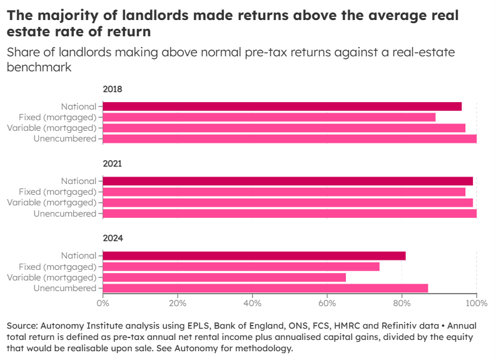
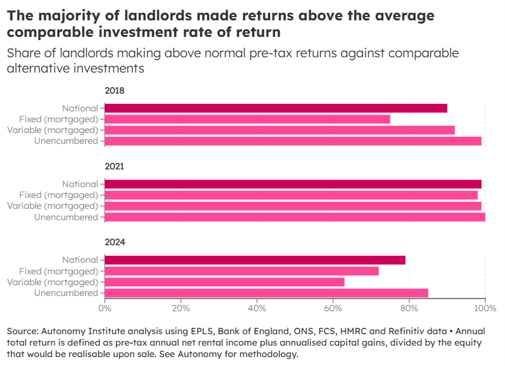
This is a really significant finding. It shows that there is little risk of creating widespread unprofitability across the sector by modestly reducing returns through a rent cap — as rental for most will still remain competitive compared to alternative investments. There is therefore a positive economic case to be made for curbing the excess returns landlords have been able to make on their investments, as well as to make rents more affordable for renters in the shorter term whilst new homes are built. Rent caps may have the effect of reducing demand for buy-to-let investment at the margins, but this shouldn’t be viewed in itself as cause for concern. Previous JRF research has shown that a reduction in demand for buy-to-let homes can benefit first-time buyers struggling to own their first home.
Modelling shows tax reforms can further mitigate risk of potential sell-offs
That said, the transition needs to be managed carefully. A minority of landlords, though a significant one, are more vulnerable than others to making a loss on the rental income side of their business: those who are heavily mortgaged and have been hit hard by rising interest rates over recent years. Introducing a rent control that constrains rental income growth, without any mitigations in place for this group, risks potentially triggering the kind of rapid sell-off that critics fear – particularly as higher interest rates continue to feed through into the market over the coming months and years.
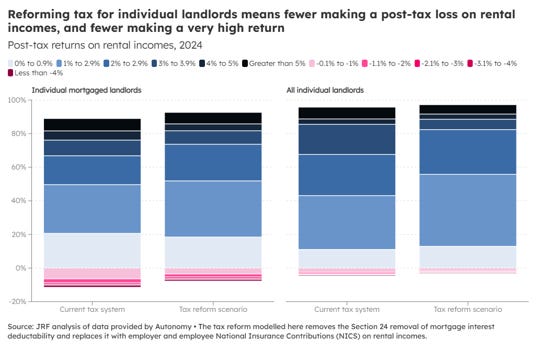
This is where tax reform can play a helpful role. How we tax income from rents is neither efficient nor particularly fair; reforming the tax regime for rental income is sensible in its own right and has broad support across the political spectrum. JRF modelling shows that reinstating full mortgage interest relief, while applying National Insurance Contributions to rental income, would rebalance the tax system in a way that relieves some of the burden on the most squeezed landlords while raising more from those making the largest profits.
Crucially, JRF’s initial modelling suggests that the combination of these tax reforms and a rent control would actually see fewer landlords making a loss on their rental income by 2030 than will be the case under the current tax system and no controls on rents. Combining rent control and tax reform would therefore tackle the rent squeeze in the near-term for renters and mitigate the risk of a sharp landlord sell-off - with some added improvements to the tax system into the bargain.
Supporting new supply is compatible with controlling rents
Policy debates about rent control in the UK often pit government intervention on rents and increasing the supply of new homes against one another. The Labour government’s decision to focus its housing policy on turbocharging the delivery of new homes has reinforced this supply-side opposition to rent controls in some quarters.
But this is a framing we must reject: the solution lies in controlling rents AND building more homes. This means combining action to cap rents with other policy interventions to build more homes – both homes for rent, and homes of other tenures - at pace. On the latter, JRF have recently set out some ways the government can use targeted investments in social housebuilding to help maintain and ramp up construction during the current market slump. And on new rental supply specifically, there are ways to design rent controls to ensure that sufficient investment incentives for new developments are maintained. Ireland’s new rent control regime, which exempts newly built apartments in perpetuity from the 2% annual rent increase cap, allowing rents to rise in line with CPI inflation, is one example that could be drawn on as inspiration.
Conclusion
The scale of affordability squeeze private renters in England have been facing for years demands bold action from the government. Of course, there are important questions about how to design effective rent caps for the English PRS that need to be got right. But as the latest JRF research and new by other organisations shows, these are not insurmountable policy design challenges for a government with the willingness to break with a stale policy consensus.
Rosie Worsdale is a Senior Policy Adviser at Joseph Rowntree Foundation, where she leads our housing and land work.
Events & news
Just a reminder that I recently hosted this podcast episode of the Urban Political looking at the political economy of the PRS. And, in case you missed it, my post on planning and one off housing is no longer behind a paywall.
What I’m reading
A great Substack post looks at the relationship between immigration and housing in Ireland, probably the best piece I’ve seen on this issue. Another insightful Substack piece takes a deep dive into the vexed issue of vacancy data. The new issue of the Radical Housing Journal includes this article on housing struggles in Barcelona, Athens and Glasgow. It also features this article, from some of the Irish academics who work with CATU, looking at emancipatory research methods.
I think a good compliment to this piece is the follow on article by HomeTruths to the one you have called out already (https://hometruths.housingsupply.ie/p/cso-the-central-signal-office).
For example, one thing that does go unmentioned here is the incentives that rent controls introduce that might result in vacancy e.g. a route back to "market" level rent through a long period of vacancy. In the Irish case, one of the exemptions that allows landlords to reset the rent to market value if the property has not been rented out at any time in the previous 2 years.